
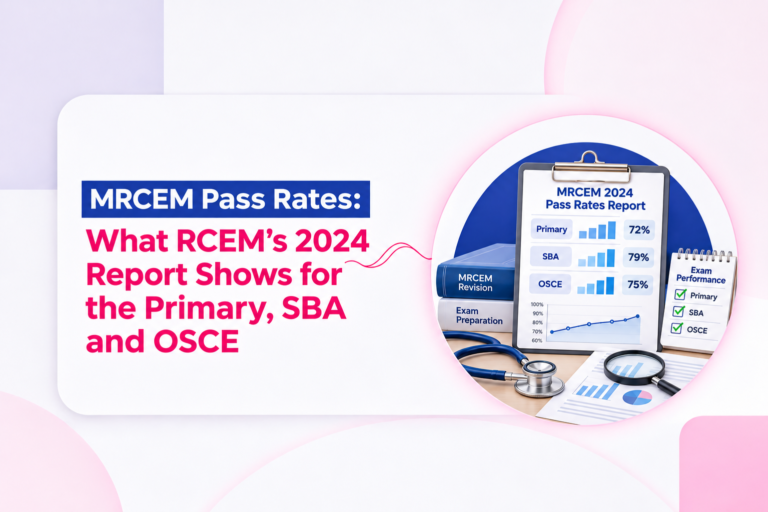
The MRCEM pass rates in RCEM’s 2024 report were 57.4% for the Primary, 30.9% for the MRCEM SBA and 80.0% for the OSCE. In other words, fewer than a third of SBA candidates passed, the lowest rate of the RCEM exams in the report, while around eight in ten OSCE candidates passed.
This guide covers the 2024 figures for each exam, the published breakdowns by work location and qualification, how RCEM sets the pass mark, what the numbers mean if you are preparing from India or the Gulf, and what to do with that information.
Table of Contents
MRCEM pass rates in 2024 by exam
RCEM’s Exam Pass Rate Report 2024 gives whole-year figures for each exam. It is the latest report we have checked, so treat these as 2024 results rather than this year’s.
| Exam (label in the report) | Passed | Total | Pass % |
| Primary SBA (Prim-SBA) | 2,770 | 4,824 | 57.4 |
| MRCEM SBA (MSBA) | 958 | 3,101 | 30.9 |
| MRCEM OSCE (MOSCE) | 980 | 1,225 | 80.0 |
| FRCEM SBA (FSBA) | 558 | 1,093 | 51.1 |
| FRCEM OSCE (FOSCE) | 562 | 697 | 80.6 |
| All exams | 5,828 | 10,940 | 53.3 |
The report labels the MRCEM Primary as “Primary SBA”, because it is also a single best answer paper. Do not confuse it with the MRCEM SBA (often still called the MRCEM Intermediate), which is the second exam in the sequence. The full report is on the RCEM website.
Two numbers stand out. The SBA pass rate of 30.9% is well below every other exam in the table, and the OSCE pass rate of 80.0% is among the highest. Across all RCEM exams, 53.3% passed.
Keep the OSCE figure in context. Everyone sitting the OSCE has already passed both the Primary and the SBA, and must meet the OSCE experience requirement, so it is a group that has already cleared two demanding written exams. The report does not explain the figure, but a high pass rate at that stage does not mean the OSCE is easy; it may partly reflect that candidates have already been filtered by the earlier exams.
Why the MRCEM SBA pass rate is the lowest
The report gives the figures but not the reasons, so what follows is a mentor’s reading rather than RCEM’s explanation. The MRCEM SBA tests your understanding of the full range of conditions and presentations you may meet in the emergency department, in two papers of 90 questions, two hours each, with a one-hour break.
That breadth is the challenge. The Primary rewards solid basic science; the SBA asks you to apply clinical judgement across the whole of emergency medicine, often in scenarios that look similar but have one better answer. If you prepare for it as a recall test, you are likely to find that hard.
The pass mark is also set higher than the raw cut score. For the SBA, RCEM determines the cut score using the Angoff method and then adds one standard error of measurement to create the pass mark. If you are working towards it, our MRCEM SBA exam guide explains the format, and our MRCEM SBA preparation guide has a 12-week plan.
Pass rates by work location and qualification
The report also breaks results down by where candidates work, where they qualified and their training status. These figures cover all RCEM exams combined, not a single exam, so they cannot tell you the MRCEM pass rates for any one paper by group.
| Group (all RCEM exams combined, 2024) | Pass rate |
| Working within the UK | 68.0% (2,430 of 3,575) |
| Working outside the UK | 46.1% (3,398 of 7,365) |
| UK graduates | 81.2% (1,373 of 1,691) |
| EEA graduates | 57.3% |
| International medical graduates (IMG) | 46.6% |
| UK trainees | 79.6% (1,367 of 1,717) |
| UK non-trainees | 57.2% |
| Republic of Ireland trainees | 48.5% |
| IMG trainees | 46.0% |
The gap between candidates working in the UK and those working outside it is about 22 percentage points across all exams. The report does not explain the gap, and it should not be read as a prediction for any individual.
How RCEM sets the pass mark
RCEM does not use a fixed percentage. Each exam uses a standard-setting method, so there is no single published score to aim for.
| Exam | How the pass mark is set |
| MRCEM Primary | Angoff method |
| MRCEM SBA | Angoff cut score, plus one standard error of measurement |
| MRCEM OSCE | Borderline regression cut score, plus one standard error of measurement |
The written exams are machine marked, with 1 mark for a correct answer, 0 for an incorrect one and no negative marking, so you should answer every question. The OSCE uses domain-based marking. We do not quote pass mark numbers. The RCEM MRCEM exams page has the official description of each exam.
What the figures mean for doctors in India and the Gulf
The report has no figures for India, the Middle East, individual centres or individual sittings, so nobody can honestly tell you the MRCEM pass rates for Indian or Gulf candidates. What it does show is that, across all exams combined, candidates working outside the UK and international medical graduates passed at lower rates than UK-based candidates in 2024.
Read that as a planning signal, not a verdict. If you work in an Indian or Gulf emergency department, you may see a wide case mix, which is useful for the SBA and OSCE. What you may have less of is exposure to UK guidelines, UK-style written questions and the communication style the OSCE expects. Those are things you can deliberately practise.
If you want structured help, StudyMRCEM runs an MRCEM SBA course, alongside courses for the Primary and OSCE; see the course page for what it includes.
How to use the MRCEM pass rates in your planning
The most useful thing about these figures is where they tell you to put your effort. The SBA deserves the longest and most structured preparation of the three exams, and you should not treat it as a quick step between the Primary and the OSCE.
A few practical steps follow from the data:
- Give the SBA proper time. Plan a structured block of timed question practice (our SBA preparation guide suggests about 12 weeks, longer if you have many weak areas), and practise sitting two full 2-hour papers in one day.
- Do not be complacent about the OSCE. A high pass rate still means some candidates fail, and the exam fee and travel make a resit costly. Our MRCEM OSCE preparation guide has a 10-week plan.
- Learn the UK framing. Practise questions written in the RCEM style and read UK guidance alongside your own clinical experience.
- Watch your attempts and the clock. You can sit each MRCEM component up to six times, plus one discretionary additional attempt you must apply for, and you have 7 years from passing the Primary to pass the SBA and OSCE.
For a full route through all three exams, read our MRCEM preparation guide.
What the pass rate data does not tell you
Published MRCEM pass rates describe groups, not you. They do not show how long candidates prepared, how many attempts they had taken or what resources they used.
They also give no figures by centre, by sitting or by country. Be wary of any pass rate quoted for a specific city, country or course unless you can see where it comes from. Your own preparation, question practice and timing will matter far more than any group average.
It is also worth remembering that a single year of data can move. Figures from one report give you a fair picture of where the difficulty lies, but they are not a fixed property of each exam. When RCEM publishes a newer report, look at it before you plan, and compare like with like: the same exam, the same groups, the same definitions.
Frequently asked questions
What were the MRCEM pass rates in 2024?
In RCEM’s 2024 report, 57.4% passed the Primary, 30.9% passed the MRCEM SBA and 80.0% passed the OSCE.
Which MRCEM exam is hardest to pass?
By 2024 pass rate, the MRCEM SBA: fewer than a third of candidates passed, the lowest rate of the RCEM exams in the report.
Are there MRCEM pass rates for Indian or Gulf candidates?
No. The report has no figures by country or centre. It gives a 46.1% pass rate for candidates working outside the UK and 46.6% for international medical graduates, but both cover all RCEM exams combined.
What is the MRCEM pass mark?
RCEM does not publish a fixed pass mark. The Primary uses the Angoff method, the SBA uses Angoff plus one standard error of measurement, and the OSCE uses borderline regression plus one standard error of measurement.
Is there negative marking in the MRCEM written exams?
No. A correct answer earns 1 mark and an incorrect answer earns 0, so answer every question.
Are these this year’s pass rates?
No. They come from RCEM’s Exam Pass Rate Report 2024, the latest report we have checked.
Talk to our MRCEM team about planning your preparation, or visit the MRCEM SBA course page.
Related guides:
- MRCEM results: when and how they are released
- MRCEM SBA exam guide
- MRCEM SBA preparation
- What is MRCEM?
Sources: