
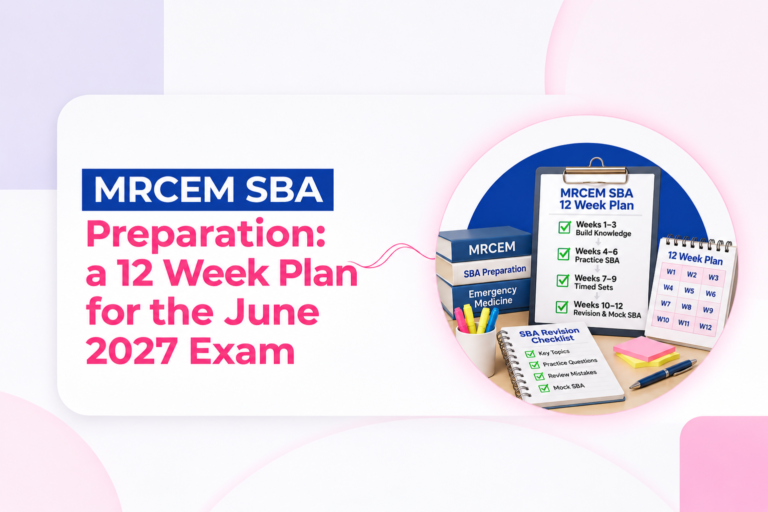
Effective MRCEM SBA preparation for a working emergency doctor can be built as about 12 weeks of structured study, built on the RCEM curriculum, daily clinical SBA questions and timed practice at the pace of two 2 hour papers. Your shifts in the emergency department are part of the plan, not a distraction from it.
This guide covers why the exam deserves respect, a 12 week plan, clinical SBA technique, learning on shift, timing for exam day and the mistakes to avoid.
Table of Contents
Why MRCEM SBA preparation needs a plan
This exam deserves a proper plan because it had the lowest pass rate of the RCEM exams in RCEM’s Exam Pass Rate Report 2024: 958 of 3,101 MRCEM SBA candidates passed, a pass rate of 30.9%. In 2024, fewer than a third of MRCEM SBA candidates passed, while around eight in ten OSCE candidates passed.
Read that figure as motivation, not as a reason to wait. It tells you that clinical experience alone is not enough and that technique, breadth and timed practice make the difference. Our MRCEM pass rates guide sets out the full 2024 figures.
The MRCEM SBA (often still called the MRCEM Intermediate) has 180 single best answer questions in two papers of 90, two hours each, with a one-hour break. Marking is 1 for a correct answer and 0 for an incorrect one, with no negative marking, and the pass mark is set by the Angoff method plus one standard error of measurement. For the full format and eligibility rules, read our MRCEM SBA exam guide.
Know your target sitting and the curriculum
Your MRCEM SBA preparation starts with a date. The January 2027 window closed on 29 October 2026, so the next sitting you can book is 2 June 2027, with applications open from 17 to 24 March 2027.
| Exam date | Applications open | Applications close | Results |
| 2 Jun 2027 | 17 Mar 2027 | 24 Mar 2027 | 14 Jul 2027 |
Counting back 12 weeks from 2 June 2027 takes you to 10 March 2027, one week before the window opens. Check that you meet the eligibility criteria before then, because RCEM assesses them at the point of application. A further sitting is listed for late 2027; check the RCEM calendar or our MRCEM exam dates guide.
The content is the full range of conditions and presentations you may meet in the ED. RCEM advises candidates to familiarise themselves with the Year 1 to 3 SLOs, so open the RCEM Emergency Medicine curriculum and use it as your checklist. Mark each area green, amber or red for confidence and let that drive your timetable.
A 12 week MRCEM SBA preparation plan
This 12 week plan assumes you work full time and can give about 90 minutes on working days and longer on days off. Adjust the order to your red areas from the curriculum review.
| Weeks | Focus | Daily target | Weekly check |
| 1 | Curriculum review, baseline set of 90 timed questions | 60 to 90 minutes | Rank areas green, amber, red |
| 2 to 3 | Resuscitation and the acutely unwell adult | 30 SBA questions plus reading | 45 timed questions |
| 4 to 5 | Medical presentations in the ED | 30 to 40 questions | Mistakes log review |
| 6 to 7 | Trauma and surgical presentations | 30 to 40 questions | 45 timed questions |
| 8 | Paediatric emergencies | 40 questions | One full paper: 90 questions in 2 hours |
| 9 | Red areas from your log | 40 questions | A second full paper |
| 10 to 11 | Full mock days and targeted revision | Two full mocks | Compare paper 1 and paper 2 scores |
| 12 | Light revision, rest, logistics | Short mixed sets | Test centre and ID confirmed |
The blocks above are a practical way to group study, not RCEM’s topic weighting. Use the curriculum itself to decide what each block contains, and keep mixed sets running throughout so earlier topics are not forgotten.
Clinical SBA technique
Good technique is the part of MRCEM SBA preparation that turns knowledge into marks. SBA questions often offer several reasonable options, and your job is to pick the best one for this patient at this moment.
Read the last line of the stem first so you know whether you are being asked for the next step, the most likely diagnosis or the most appropriate investigation. Then read the stem for the details that change management: age, observations, timing, comorbidities and what has already been done. Try to answer before you look at the options, then choose the option closest to your answer.
When two answers both look right, ask which one a senior emergency physician would do first. Safety, resuscitation and time-critical treatment usually come before definitive investigation. Avoid answering from local habit alone: when your hospital does things differently from UK guidance, look up the guidance and learn the reasoning.
Using your ED shifts as study time
Your shifts are the best MRCEM SBA preparation resource you have, if you use them on purpose. Each shift, pick one or two patients and ask what the exam would ask about them: the key decision, the red flags, the drug and dose, the disposition.
Keep a small notebook or phone note of these cases and turn each one into a question for yourself later that day. Ask seniors why they chose one approach over another, since that reasoning is exactly what clinical SBA questions test.
Quiet night shifts can hold a short set of SBA questions. After a busy shift, do something lighter, such as reviewing your mistakes log for 15 minutes. Consistency over 12 weeks beats long sessions you cannot sustain.
If you want structured help alongside your own study, StudyMRCEM runs an MRCEM SBA course; see the MRCEM SBA course page for what it includes.
Timing two 2 hour papers
Each paper gives you 120 minutes for 90 questions, about 80 seconds per question. Clinical stems are long, so practise SBA questions at that pace from week 8 onwards. The checkpoints below run slightly faster than 80 seconds, which leaves about ten minutes to review flagged questions.
| Time into each paper | Target question number |
| 30 minutes | Around 24 |
| 60 minutes | Around 49 |
| 90 minutes | Around 73 |
| 110 minutes | 90 answered, flagged ones under review |
Answer everything on the first pass because there is no negative marking. Flag and move on when a question takes more than two minutes. Treat the one-hour break as part of the exam: eat, drink, step away from the screen and do not review paper 1 in your head. In your full mocks, rehearse the break as well, so your concentration in paper 2 is not a surprise on the day.
Common mistakes in the final weeks
The final fortnight of MRCEM SBA preparation is for consolidation and full mocks, not new textbooks. These are the mistakes worth avoiding:
- Relying on clinical experience and skipping timed SBA questions.
- Studying only your favourite topics instead of your red areas.
- Never sitting a full four-hour mock with a break.
- Reading explanations without writing down why you were wrong.
- Using outdated material built for the old exam format.
- Missing the seven-day application window, since late applications are not accepted.
Results arrive approximately 6 to 8 weeks after the exam, in your RCEM account. Remember that your 7 years to complete all MRCEM exams started when you passed the Primary, so plan your OSCE timing too.
Frequently asked questions
How long does MRCEM SBA preparation take?
For a doctor working full time, about 12 weeks of regular study is a realistic plan. Allow longer if your curriculum review shows many red areas.
How many SBA questions should I do each day?
Aim for 30 to 40 questions on most days, with full explanation review. The quality of your review matters as much as the number.
How much time do I have per question?
Each paper has 90 questions in two hours, so about 80 seconds per question. Practise at that pace in timed sets.
What was the MRCEM SBA pass rate?
In RCEM’s 2024 report, 958 of 3,101 candidates passed, a pass rate of 30.9%. It was the lowest rate of the RCEM exams in that report.
Can I prepare while working full time in the ED?
Yes. Use your shifts for case-based learning and protect short daily study blocks for your MRCEM SBA preparation, with longer sessions on days off.
Which sitting should I aim for?
The January 2027 window has closed, so the 2 June 2027 sitting, with applications from 17 to 24 March 2027, is the next to plan for.
Talk to our MRCEM team, or see the MRCEM SBA course page for what it includes.
Related guides:
- MRCEM eligibility explained
- MRCEM fees for 2027
- MRCEM results and what comes next
- MRCEM OSCE preparation
Sources: