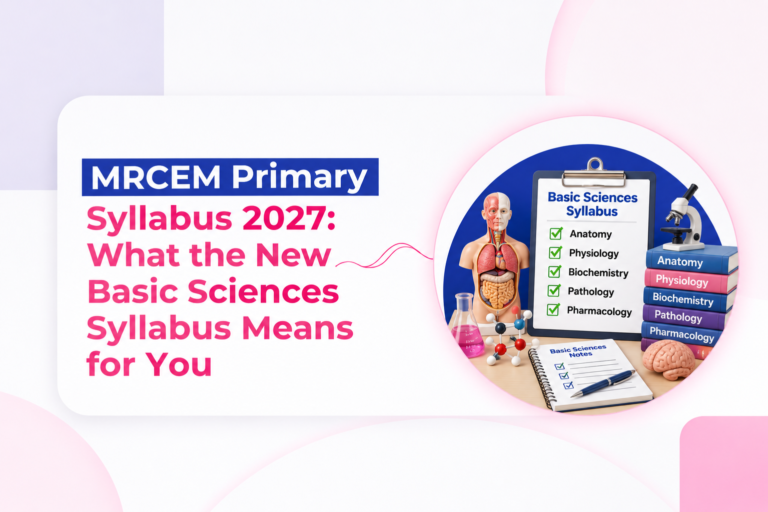
MThe MRCEM Primary syllabus is changing: RCEM has launched an updated Basic Sciences Syllabus, which becomes the official syllabus for the MRCEM Primary from the 21 April 2027 sitting onwards. If you sat the October 2026 Primary, you prepared on the current syllabus; if you are aiming for April 2027 or later, you should now work from the new one.
This guide covers what RCEM has announced, which syllabus applies to each sitting, what has not been confirmed, and how to adjust your study plan whichever exam you are targeting.
Table of Contents
What changed in the MRCEM Primary syllabus for 2027
RCEM has published a new Basic Sciences Syllabus, and it is the first update since 2010. The College announced on 3 August 2026 that a new syllabus would apply from 2027, and on 28 October 2026 it confirmed the launch of the updated document as the official syllabus for the Primary from 21 April 2027.
According to RCEM, the new MRCEM Primary syllabus “will build on the existing disciplines” of anatomy, physiology, pharmacology, microbiology, pathology and evidence-based medicine. It was “developed to reflect modern Emergency Medicine practice”. In other words, the familiar disciplines remain the backbone of the syllabus; RCEM’s announcements do not set out topic by topic what has changed, so the official document is your reference.
RCEM has also added an overview video, posted on 3 November 2026, which it asks candidates to watch alongside the official syllabus documentation. Treat the video as an orientation and the written syllabus as the reference you plan from. You can open the syllabus on the RCEM curriculum site and read the announcement on the RCEM news page.
Which syllabus applies to your sitting
The rule is simple: the October 2026 Primary used the current syllabus, and every Primary from 21 April 2027 uses the new Basic Sciences Syllabus. RCEM said directly that candidates for the October 2026 exam “should continue to prepare using the current Basic Sciences Syllabus”.
Here is how that maps onto the dates on the RCEM calendar.
| Primary sitting | Applications open | Applications close | Results | Syllabus that applies |
| 27 Oct 2026 | 15 Jul 2026 | 22 Jul 2026 | 1 Dec 2026 | Current syllabus |
| 21 Apr 2027 | 20 Jan 2027 | 27 Jan 2027 | 2 Jun 2027 | New syllabus (first sitting) |
| 20 Oct 2027 | 23 Jun 2027 | 30 Jun 2027 | 1 Dec 2027 | New syllabus |
Windows open at 10am UK time and close at 4pm UK time on the closing date, and RCEM does not accept late applications. For the full calendar across all three exams, see our MRCEM exam dates guide, and for the cost of each sitting, our MRCEM fees guide.
What RCEM has not confirmed yet
RCEM’s announcements do not include a topic-by-topic comparison of the old and new MRCEM Primary syllabus or any question weightings per subject. That matters, because a lot of advice circulating in study groups claims to know exactly which topics were added or dropped. Unless the claim points to the official document, treat it as a guess.
Be equally careful with old blueprints. Question counts per subject that you may have seen in older notes or forum posts describe the previous exam, and you should not assume they carry over. The safest approach is to put the official syllabus beside your notes and compare them line by line yourself.
A few things you should not assume:
- That the exam format has changed. The format published on the RCEM MRCEM exams page is what you should plan around, so check it before your sitting.
- That your old notes are useless. The core disciplines remain, so much of your existing work is likely to stay useful once you have checked it against the new document.
- That a third-party list of “new topics” is accurate. Use the RCEM document as the only authority.
How the Primary exam works
The Primary is a single theory paper of 180 single best answer questions in one section, lasting 3 hours. It is machine marked: a correct answer earns 1 mark, an incorrect answer earns 0, and there is no negative marking, so you should answer every question.
The pass mark is set using the Angoff method. RCEM describes the exam content as the RCEM Basic Sciences Curriculum (Oct 2026) and says the Primary is mapped to the Emergency Medicine 2021 Curriculum. Results are published by 17:00 on a pre-advised day, roughly 6 to 8 weeks after the exam, and they appear in your RCEM website account.
The written exams are delivered at computer-based test centres worldwide by Surpass Assessments. If you are in India or the Gulf, check test-centre availability in your country when you apply. Our MRCEM Primary exam guide covers the format and rules in more detail.
If you sat the October 2026 Primary
If you took the Primary on 27 October 2026, your results are due on 1 December 2026, and nothing about the new MRCEM Primary syllabus affects that result. The question is only what happens if you need another attempt.
Any resit from April 2027 onwards will be on the new syllabus. So if you are waiting for results and think you may need to sit again, it is sensible to download the new document now and start mapping it against your notes, rather than losing December. The April 2027 window is short: it opens on 20 January 2027 and closes on 27 January 2027.
Remember that you can sit each MRCEM component up to six times, with one discretionary additional attempt that you must apply for. Our MRCEM results guide explains how results are released and what to do next.
How to plan for April 2027 or later
If you are starting now, build your plan on the new Basic Sciences Syllabus from day one. For April 2027 you have roughly five months, which is enough for a structured run through all six disciplines plus time for timed question practice.
A simple way to organise the months ahead:
| Phase | Approximate timing for April 2027 | Focus |
| Map | Late November to early December 2026 | Read the new syllabus, watch the RCEM overview video, mark gaps against your notes |
| Build | December 2026 to February 2027 | Work through anatomy, physiology, pharmacology, microbiology, pathology and evidence-based medicine |
| Apply | 20 to 27 January 2027 | Submit your application during the window |
| Practise | February to March 2027 | Timed single best answer sets, review weak areas |
| Consolidate | April 2027 | Full 180-question mocks in 3 hours, light revision |
If you work full shifts in an Indian or Gulf emergency department, the mapping phase is a sensible first step. It tells you where your existing reading still fits and stops you redoing topics you already know. If you are planning for October 2027 instead, the same phases simply stretch over a longer run. Our MRCEM Primary preparation guide has week-by-week plans you can adapt.
If you would like structured support while you adjust to the new syllabus, StudyMRCEM runs an MRCEM Primary course; see the course page for what it includes.
Common mistakes with the syllabus change
The biggest mistake is ignoring the change because “basic sciences are basic sciences”. The disciplines are the same, but RCEM wrote the new MRCEM Primary syllabus to reflect modern practice, so use it as your checklist rather than an old one.
The opposite mistake is panicking and starting from scratch. Your anatomy, physiology and pharmacology knowledge is still relevant, so the job is to compare, fill gaps and practise, not to rebuild everything.
Other errors worth avoiding:
- Studying from an old syllabus PDF saved on your phone or shared in a group. Download the current document from the RCEM curriculum site.
- Missing the January window. Seven days is short, so set a reminder; RCEM offers email reminders for window openings.
- Forgetting the 7-year clock. Your 7 years to complete all MRCEM exams starts when you pass the Primary, so plan the SBA and OSCE that follow.
Frequently asked questions
When does the new MRCEM Primary syllabus start?
It applies from the 21 April 2027 Primary onwards. That is the first sitting on the updated Basic Sciences Syllabus.
Which syllabus applied to the October 2026 Primary?
The current syllabus. RCEM said candidates for the October 2026 exam should continue to prepare using the current Basic Sciences Syllabus.
Has RCEM published a list of new or removed topics?
Not in the announcements we checked. RCEM says the new syllabus builds on the existing disciplines and reflects modern emergency medicine practice, so compare your notes with the official document yourself.
Are the same subjects still covered?
RCEM says the syllabus builds on anatomy, physiology, pharmacology, microbiology, pathology and evidence-based medicine. Those remain the core of your preparation.
Has the Primary exam format changed?
The RCEM exams page lists the Primary as 180 single best answer questions in one 3-hour section, machine marked with no negative marking. Check the page again before you sit.
If I fail the October 2026 Primary, which syllabus will my resit use?
Any resit from April 2027 onwards uses the new MRCEM Primary syllabus. Start mapping it against your notes while you wait for results.
Where can I find the official syllabus?
On the RCEM curriculum site, which RCEM links from its announcement. RCEM also posted an overview video to watch alongside the document.
Talk to our MRCEM team if you want help planning your Primary around the new syllabus, or visit the MRCEM Primary course page.
Related guides:
- MRCEM Primary exam: format, marking and results
- MRCEM Primary preparation plans
- MRCEM exam dates 2026 to 2027
- What is MRCEM?
Sources:
RCEM: New Basic Sciences curriculum launched (28 Oct 2026)
RCEM: New Basic Sciences syllabus to apply from 2027 (3 Aug 2026)